Issue 032 | Friday Brief | November 27, 2026
A Real Credential. An Unauthorized Decision.
Weekly field intelligence for enterprise and mobile security leaders
The day before Thanksgiving, 1Password disclosed that an attacker had gained access to an employee’s corporate GitHub account, reached backend systems and copied administrative information for a subset of its customers. The company’s security architecture protected customer vault contents and the keys securing them.
That protection deserves credit. The incident still presents a serious question for enterprise security leaders. An attacker used an employee account to reach source code and introduce malicious changes into systems handling customer information. The investigation now extends beyond containing the compromised credentials to understanding the permissions, controls and approvals surrounding those actions.
The exposed administrative records included names, email addresses, account identifiers and tokens associated with certain invitation, provisioning and recovery processes. The tokens required additional authentication, and 1Password reported no internal evidence of account takeovers through the exposed provisioning tokens.
There is still a board-level problem to address. Personal information was exposed, creating opportunities for targeted phishing and questions about incident-response costs, notification requirements and privacy obligations. The applicability of laws such as the GDPR and CCPA depends on the affected data, individuals and jurisdictions.
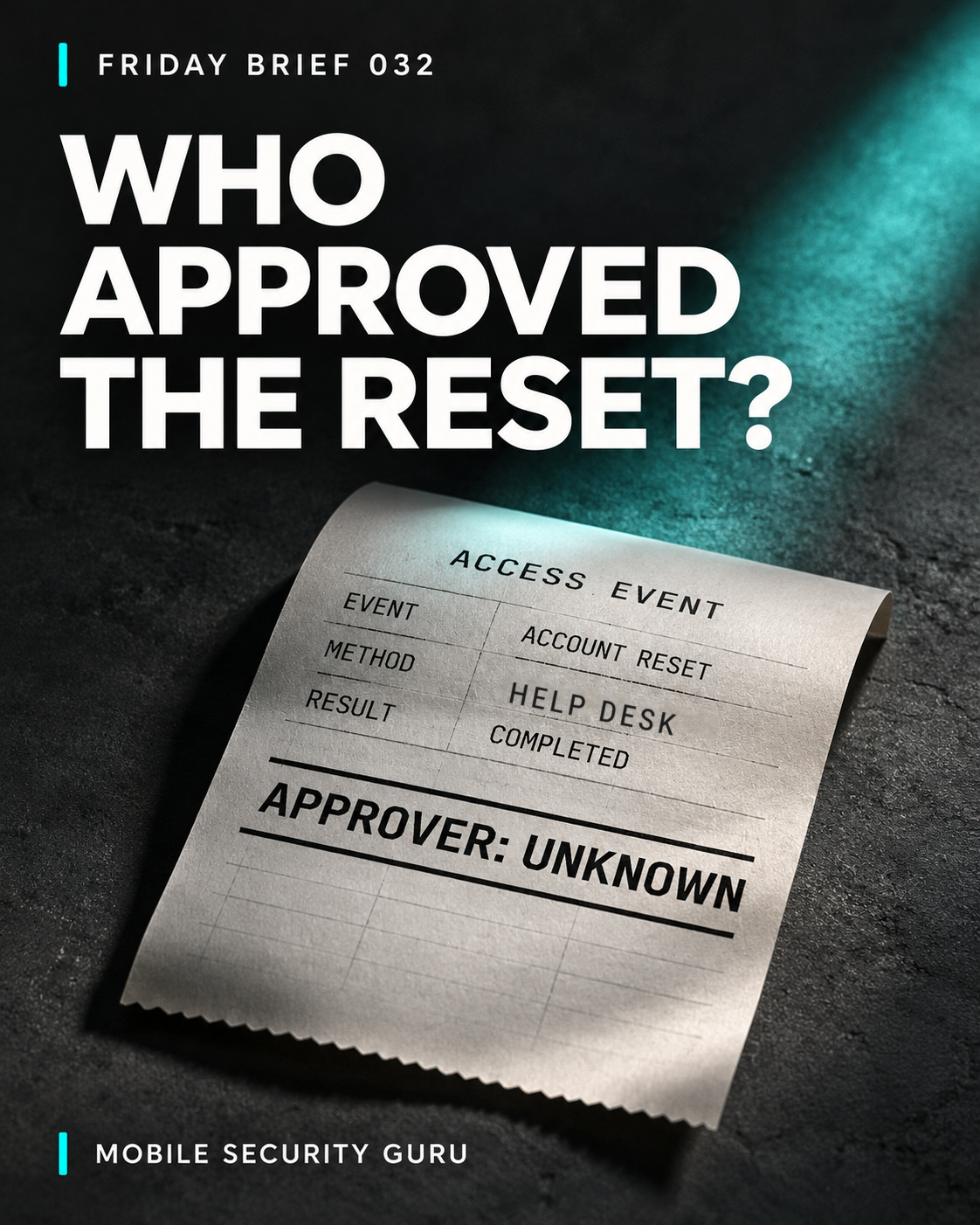
An authentication log can show which credential a system accepted. An authorization record should establish which actor was permitted to perform the specific action, on which resource, under what conditions and for how long.
I want the record connecting those two decisions. That is the part of a recovery or privileged workflow I would ask an independent reviewer to reproduce.
Signals & Moves You Shouldn’t Ignore
1Password: The vault boundary held while administrative data was copied
On November 25, 1Password reported that an attacker gained access to an employee’s corporate GitHub account, copied private source code, reached its CI/CD environment and pushed malicious code to backend services. The code downloaded administrative records for a subset of customers.
Those records included names, email addresses, account identifiers, account creation and last-sign-in times, public keys, certain protocol parameters and tokens from selected invitation, provisioning and account-recovery emails.
Customer vault contents and the keys protecting them remained secure, according to 1Password. The company also stated that the exposed tokens could not independently complete account recovery or provisioning. Additional authentication was required, and its investigation found no internal evidence of account takeovers using those provisioning tokens.
Protecting the vault was a successful security outcome. The incident still required the company to respond to unauthorized access, exposure of customer administrative information and compromise of its development environment.
The board needs to understand what information was accessed, what obligations follow and how the organization has established that the attacker can no longer use the compromised access. Customer names, email addresses and account information can support more convincing phishing attempts. Regulatory exposure and notification duties require their own assessment rather than an assumption that every disclosure constitutes a legal violation.
1Password disabled the affected account, revoked the stolen token, removed access the attacker created, rotated potentially exposed internal credentials and tightened GitHub, CI/CD and endpoint controls. It also increased verification codes used in certain invitation and recovery processes from six numeric digits to ten alphanumeric characters.
The longer codes make guessing substantially harder. They address a different part of the problem from the permissions that allowed the compromised account to reach the development and deployment environment.
I want to know how the attacker gained control of the employee account, which permissions made the subsequent actions possible, what approval controls applied to changes reaching backend services and which records would allow an independent reviewer to reconstruct the sequence.
The public disclosure does not answer every one of those questions. It also does not establish that the company’s customer recovery approval process was bypassed.
I would use the incident to examine my own environment. Select a completed privileged change or recovery event, retrieve the original request and the evidence available at the time, identify the authorized decision-maker and verify the action that followed.
Source: 1Password, November 25, 2026.
FCC: December SIM-swap and port-out deadlines
Federal Register notices published November 17 and 18 established compliance dates for covered wireless providers under the FCC’s SIM-swap and number port-out protections.
The relevant SIM-swap requirements have a December 17, 2026 compliance date. The port-out requirements have a December 18 compliance date.
The regulations address customer authentication, notifications, account protections, fraud investigation and related records. Their scope and exceptions determine which obligations apply to a particular provider.
For the enterprise, the problem appears when a telephone number becomes part of an identity-recovery decision.
A help-desk operator may receive a request from an employee who has lost a device, changed phones or cannot complete MFA. The telephone number may appear in the recovery process as evidence associated with the employee.
A recent SIM change or number port can alter what that evidence establishes. A carrier check may inform the help desk that the number has changed. The enterprise still owns the decision to restore access to a corporate resource.
The carrier’s responsibility ends at the controls governing its service, which leaves the enterprise holding the authorization for its own accounts and applications.
Those records should be connected where the workflow depends on both.
For a high-impact recovery, I would want the request, the relevant carrier evidence, the identity evidence, the approving authority and the resulting account change available in the original ticket or through durable references.
The December dates make this a timely review for carriers and the organizations relying on telephone numbers in recovery. They do not, by themselves, require enterprises to purchase a particular product or use a specific vendor check.
Sources: Federal Register, November 17 and 18, 2026.
CrowdSec: The credential remained after the employment relationship changed
CrowdSec’s September investigation describes an incident that occurred on May 22.
An attacker copied approximately 170 private GitHub repositories using access associated with a recently departed developer. CrowdSec traced the stolen token to the May TanStack npm supply-chain compromise. The company had retained that access temporarily so the developer could complete unfinished work.
The compromised access was removed on May 25. CrowdSec reported that its production infrastructure and databases were not compromised and that the copied code had not been modified.
The original decision to retain access had a legitimate business reason. The attack exploited access that remained available during that exception.
That distinction should concern anyone responsible for offboarding, vendor access or temporary administrative privileges.
An employee can leave while a credential remains technically usable. The same condition shows up when a contractor finishes the agreed work and the service account keeps its permissions, or when a vendor returns through an access path set up for an earlier engagement.
The record I would examine identifies who authorized the continued access, which repositories or resources were included, what work the exception permitted, when it was supposed to end and who owned the revocation.
A valid token is evidence that a system accepted the credential. The organization also needs evidence showing that the use was within the authority granted.
Source: CrowdSec, September 18, 2026, describing events from May 22.
The Control Gap
Authentication can succeed while the business authority is wrong
Consider a high-value financial transaction.
The approver’s identity may be verified successfully. A separate record must establish whether that person was authorized to approve the amount, beneficiary, purpose and timing of the transaction.
At sufficient scale, that distinction becomes a board-level question. An organization may be able to show every successful authentication event and still struggle to prove who approved a consequential transfer under the applicable delegation of authority.
The same problem appears in password resets, MFA recovery, privileged deployments and vendor re-entry.
An access log identifies what the system accepted or observed. The authorization record establishes the decision permitting the specific action, within an applicable scope and time window.
For a help-desk reset, the minimum reviewable record should identify the original request, relevant account or resource, approving authority, evidence considered, permitted action, decision time and observed result.
The authority must also be current. Time binding is essential because a previous approval may no longer apply after an account, device, telephone number, employment relationship or business condition changes.
A manual review receipt can document those facts and identify missing evidence. A cryptographically verifiable authorization receipt can additionally establish issuer authenticity, integrity, audience and action binding, validity and other defined verification conditions.
Those forms of evidence should not be confused. A spreadsheet marked APPROVED does not establish cryptographic authenticity, and a valid signed receipt does not independently prove that the underlying business decision was correct.
A record becomes useful when it allows the appropriate reviewer to establish exactly which decision was made, what authority applied and which outcome followed.
My Take
Help desks routinely restore access to people who cannot complete their usual authentication process. The operator may have to weigh several forms of evidence while managing a real business interruption.
The architecture behind that workflow determines whether the resulting decision is defensible. More automation, including AI agents, can increase the speed and volume of actions performed through existing permissions. Weak approval boundaries can be repeated just as efficiently as strong ones.
A password reset, an MFA re-enrollment, a changed SIM and a vendor’s return to an account introduce different risks. The common dependency is the authority that permits the next action.
A successful login after recovery proves that the user passed the authentication checks required by the system at that moment. It does not independently explain the organizational authority behind the recovery.
I would start with one completed case.
Locate the original request, identify the approving authority, retrieve the evidence considered and compare the recorded decision with the action that occurred. Then give the evidence to someone who did not handle the original ticket.
That person should be able to establish what was approved, when the approval applied and what happened afterward.
Record UNKNOWN wherever the information is missing. A missing record is a finding. An explanation reconstructed weeks later is weaker evidence than the decision recorded when it occurred.
This is the same discipline I want applied to vendor access, privileged changes and financial approvals. The system may have completed its technical task correctly while the organization lacks a defensible record of the authority behind the result.
I want that gap visible before the next incident, audit or disputed decision.
-W
One Thing Worth Doing This Week
Build the Recovery Authority Register. Keep the Receipt.
Start with seven recovery and access paths: help-desk password reset, MFA re-enrollment, self-service recovery, new-user invitation, SIM or telephone-number change used for MFA, new-device registration and vendor re-entry after a lapse.
For each path, identify who can initiate the request, which evidence is checked, who has authority to approve it and where the authorization is recorded.
Then select one completed event and produce a Recovery Authority Review Receipt.
The receipt should identify the event, requested capability, actor or requester reference, resource, approving authority, evidence reference, approval time, permitted action and observed outcome. Include the applicable expiration, exception or recheck record.
Keep personal information, credentials and recovery codes out of the shared worksheet. The source systems should retain the underlying evidence under their existing access controls. The review record should contain only the references necessary to retrieve it.
Give the completed receipt to a second reviewer.
The result should establish the original decision and its outcome without requiring a conversation with the person who handled the request. The reviewer should be able to identify any missing evidence and distinguish the recorded approval from a later explanation.
Download: Recovery Authority Register + Review Receipt (PDF)
The free template includes all seven event paths, a synthetic worked example and a blank receipt for reviewing one real event.
It is a manual audit artifact, not a cryptographically signed Mobile Trust Boundary authorization receipt.
Field Notes | IEEE
I spent an evening this week at an IEEE session on the next generation of utility meters. The new ones carry a second processor for software agents, and I asked how a utility proves an update on that side never touches the measurement the bill legally depends on.
The answer was candid: vendors have to show the regulator that the separation exists, and the speaker had not yet seen that documentation.
The story I carried home came from someone who works meter theft cases. The utility’s workflow saw the meter come offline for a short time and then back on, an anomaly that would otherwise be difficult for a human to spot. It had been disconnected by a thief, who then hooked the meter up at a location he preferred.
Look at what the network saw: a genuine meter with valid credentials, reporting on schedule. Every check that asks whether this is a real meter passes. What caught him was a record tying that meter to one socket on one account.
The utility told the room it now reaches an address within 10 days of data flagging a problem, where it previously could take months. That is the account I heard, rather than an independently verified industry performance figure.
The meter story puts a physical consequence behind the authorization question. The device was genuine, but its assigned location had changed without permission. A phone number can also move to a new SIM while remaining the same number. Enterprises relying on that number for recovery need to account for the change before restoring access.
The 1Password incident is technically different. Its disclosure concerns compromised employee access, malicious code and administrative records. It has not established that the exposed recovery tokens were independently usable or successfully used to take over customer accounts.
The useful connection is the evidence required to establish that a recognized credential or system state remains appropriate for the action being requested.
How many days pass before your help desk learns that a number moved?
Reset Check brings carrier SIM-change evidence into the help-desk reset decision and retains a record of the check. It is live on AT&T and launches December 1. Verizon has approved it.
Reset Check: https://reset.buildinhouse.com
Cleared Today | Part 11: Federations
When the leadership term ends, who removes the authority?
Federated organizations distribute responsibility across local units, elected officers, committees and administrative systems. Their governance records establish who may act on behalf of the organization.
Rotary provides a useful example because its leadership year ends June 30.
The leadership transition can change who is authorized to approve financial transactions, administer accounts, represent the organization or direct work. The technology supporting those responsibilities may require separate access changes.
A former officer may retain a technically valid account after the relevant authority has expired. A newly appointed officer may authenticate successfully without yet having the required authority recorded for a particular action.
Neither condition proves that Rotary or any specific organization has an access-control failure. They identify what an operator should test during a leadership transition.
The practical review begins with the governing role, the relevant organizational unit and the effective dates. It should then establish which permissions were transferred, withdrawn or retained by approved exception.
That review needs a named owner and an inspectable record. Financial permissions, shared accounts, delegated administration and third-party services deserve particular attention because they may sit outside the primary membership or identity system.
For federations with different governance calendars, the actual term dates and authority rules must come from their own governing documents.
The June 30 example belongs specifically to Rotary.
The test is whether a reviewer can establish that the previous officer’s authority ended when the governing term ended, while confirming that the incoming officer’s permissions began within the approved scope.
Cleared Today question: Which record proves that the outgoing officer’s authority was withdrawn from every system where it was granted?
EVERY FRIDAY. SIGNALS. ONE CONTROL GAP. ONE ACTION.
Who in your organization can produce the approval record for a consequential reset or access decision without reconstructing the event from memory?
Get the 2026 Mobile Risk Report
Sources
1. 1Password, November 25, 2026: Security incident involving backend systems
2. Federal Register, November 17, 2026: SIM-swap compliance date
3. Federal Register, November 18, 2026: Number port-out compliance date
4. CrowdSec, September 18, 2026: TanStack Supply Chain Attack Analysis
5. William Haynes, IEEE session and subsequent meter-theft discussion, firsthand Field Notes, November 2026.
6. MSG editorial record, MOB-1134, Cleared Today Part 11: Federations.